Showing posts with label Sandy. Show all posts

Tuesday, February 11, 2014

An after action report that does not mince words..

The National Center for Security and Preparedness are in the midst of compiling an After Action Report on Sandy and New State OEM's response...words are not minced:

"NOTE: Blue-bolded and italicized texts contain information intended only for the Commissioner of the New York State Division of Homeland Security and Emergency Services. 

"OEM is extremely understaffed. By comparison, Iowa's emergency management agency, serving a state with the same area as New York but only a sixth the population, is as large as OEM. The profound demands on an overtaxed staff during its many activations, as well as under performance by a vocal and unmotivated minority have severely degraded morale and compromised effectiveness. Designating emergency management staff as nonessential personnel to facilitate early retirement and a subsequent failure to fill empty positions has further eroded OEM’s capabilities.  ""

One of the biggest revelations was the New York State OEM's staff has been reduced by 50% since 2011, from 125 to approximate 65 post-Sandy.


The report blasts Staff management, morale, outdated technology, strategy and response planning, etc...The report is clear, concise, and highlights vulnerabilities that will / have impacted recovery and New York State's ability to respond to future events. 

Friday, January 24, 2014

Designing resilience into the fabric of our cities

In a similar vein to yesterday's post on the potential impacts the rapid increase in urban populations will have on our ability to prepare for, respond to, and recover from disasters, this article from the folks at Fast Company is about one vision that integrates resilience into our cities working with the space that's already available.

If the world did as Mr. De Chant's 'Per Mile Squareinfographic suggests and underwent a hyperdensification, stacking on top of itself to achieve NYC levels of population density, then there would need to be modifications made to that environment that promotes / reinforces the resilience we are currently striving to create. The real world application of what these resilience strategies would look like are explored in this article and are lumped together and classified as 'green infrastructure.'
Image © Gensler
Remember that if the world is going to live like New Yorkers do, then roughly the same wasted space would need to be accounted for...in the case of NYC, that's roughly 5.3 million square feet of space, or roughly 92 football fields. This manifests itself in concrete traffic medians, vacant lots, and barren space that is waiting to be transformed. When you think of New York City, wasted space is not a concept that comes to mind, which is why this idea of transforming the "dead space" that is there into something that can work to promote resilience in the face of increased severe weather events is so cool.

When we think about cities, the prevailing mindset is that there is no room to do anything, overcrowding, poor sanitation, noise pollution, visual blight, and we've been programmed to believe that it stems from the model of our urban infrastructure. What it is though is a reluctance to invest in ideas that would transform that blight into opportunity. What Eric Tan of Gensler has done is to take existing "dead space" and repurpose it, so that it can help an overwhelmed municipal sewer system during strong deluges by creating absorbent surfaces that "eat" water. Or capturing solar energy in current "dead space" by building solar panels and charging stations to mitigate the need for power to charge mobile devices post-event.

These ideas are just that...ideas, but they open the door to what can be done to make our urban environments nicer places as well as places that work harder for us, helping us cope with a future of stronger and more frequent severe weather events.

Mr. Tan goes beyond the repurposing of existing dead space and explores what entire systems could look like from Storm Water Management, to Organic Waste Recyclers in a re-imagined urban setting. For more on his work check out: http://www.gensleron.com/cities/2013/6/10/town-square-initiative-new-york.html.
Image © Gensler
While hyperdensification brings with it lots of added benefits of space utilization, mass transit, opportunity for resource growth, etc...it also would compound the challenges faced when responding to disasters large and small. More people means more resources needed to evacuate, more shelters, better messaging on what to do, and a host of access issues ranging from infrastructure to accommodating individuals with disabilities. As our total population grows, this idea of re-imagining how we use our space will go from abstract to RFP rather quickly.

And for those who don't believe the density issue will quickly be pushed to the forefront of preparedness and recovery planning need look no further than the Post-Disaster Housing Prototype Program launching in New York City. The density issue is already being felt in the world of disasters and as more bodies migrate to urban centers, the ability to retrofit the space we currently use or have available while aligning it with the needs of the population will be crucial as we adjust to our new urban reality.

Wednesday, November 13, 2013

A way forward for the Philippines

You can only look at so many images of flattened homes and decimated communities or hit the refresh button so many times for updated information on damage estimates before it gets too macabre. While finding fault in this is hard, as I find infographics to be a useful and engaging tool for communicating information, the slick packaging of human misery doesn't feel appropriate at this juncture. I realize the inherent hypocrisy in this sentiment given that my last post praised the Filipino government for quickly publishing quantifiable data on the storms impacts, and it's precisely that information that makes communication pieces like this one possible...but what can I say, I'm fickle.


So instead of waiting for updated stats to tell me what I already know, that this is a major humanitarian crisis, I began to think about how the Mid-Atlantic region would fair if a storm like Yolanda were to hit. The tale of the tape shows that Sandy was a Cat 1 storm with sustained winds of 75mph, and Yolanda a Cat 4/5 with sustained winds of 150 mph with gusts over 170mph. But the damage in the Mid-Atlantic wasn't due to the winds, it was due to the storm surge; Sandy brought a surge of roughly 10ft to coastal communities and went inland for distances measured in blocks. Yolanda's surge was thought to be between 15-20ft and in some cases wiped whole island communities off the map. Drawing these comparisons doesn't change the reality millions of people in the Philippines or the mid-Atlantic region are facing, but it does help by providing perspective. And while far from scientific, the below image is what Yolanda would look like if it made landfall along the eastern seaboard--covering roughly 1200 miles while Sandy's diameter was approx. 950 miles.

Credit: Derek Medlin / Google Earth
So what's being done? If you go by the media's account, aid is slow to arrive and there is confusion on the ground. Some articles go as far as to chastise aid agencies for not learning from past events: The Haiti Earthquake or The Japan Quake/Tsunami. Articles alluding to the fact that response agencies are fumbling the ball resulting in delays in the disbursement of aid began as frustrations amongst survivors reached a fever pitch. What is often overlooked is that it's day 5 following a major event with a significant impact not only on the fabric of communities, but on the infrastructure that allows those communities to function on a daily basis. When that infrastructure is disrupted, its restoration and the delivery of aid that follows will take longer than a business week to bring online.

In addition to the push to reconnect supply chains that will facilitate the flow of aid, OCHA has created an action plan, with objectives, goals, dollar requirements, and lead agencies charged with making it happen. So I guess if you come up with a comprehensive plan to begin to bring order to the chaos, you get a pass and can publish infographics whenever you want.

The plan is based on the cluster system being implemented and while the plan will undoubtedly go through revisions, it's nice to read about a way forward, about a plan to deal with the monumental effort of bringing normalcy back to these impacted communities. I hope that the issuing of this plan marks a turning point in the reporting on the event and that news agencies will choose to dig a little deeper and find stories that highlight a way forward rather than to rehash the horrible tragedy that's already happened.
https://philippines.humanitarianresponse.info/document/typhoon-haiyan-action-plan
Learning from the past is how we avoid having history repeat itself, but now is not the time for finger pointing or assigning blame. Now is the time to use the resources available to ensure that no further loss of life occurs while laying the foundation for a response to an event that will take years to fully recover from.

Friday, November 1, 2013

Nonprofits and Long Term Recovery

Volunteers and nonprofit organizations have an undeniable impact on expediting a community's recovery in a post-disaster timeframe. The depth of experience and resource brought to bear by voluntary organizations can have a significant impact on the speed at which recovery progresses in communities on the mend. Volunteers and the nonprofit organizations that exist to support their activities are cornerstones of recovery efforts; from cooking and distributing meals and doing the physical work of mucking, gutting, and debris removal, to disaster case management and repair and rebuild work, nonprofit resources provide continuity as a community transitions from response into long-term recovery (LTR). Key to leveraging those resources however, comes with better understanding the types of challenges nonprofits face in sustaining LTR efforts.

Before looking at these unique challenges, one needs to understand the role nonprofits have as recovery plays out. To put it simply, they are the one's who provide the resource: human, material, financial, and experiential that guide and drive the long-term recovery process. In partnership with residents and local officials, nonprofits can be a wealth of insight to help steer Long Term Recovery Committees. And yet, even with all the responsibility that falls to local and national nonprofits to advocate and move the needle in a positive direction day after day, there are challenges. Because nonprofits rely on the goodwill of the communities they serve, after a point in time as a community tries to re-establish a new normal, some of that goodwill can be eroded.
  1. Progress is powered by people. Response is dominated by the spontaneity of volunteers proactively addressing unmet community needs. What usually starts as an overwhelming crush of interest quickly dwindles. Because nonprofits rely on a volunteers, their ability to sustain operations 6-12 months down the road can be compromised when the flow of volunteers has been reduced to a trickle. The changing seasons, competition for people's time, and a lack of media attention highlighting the needs can make generating interest a challenge. When nonprofits don't have a consistent workforce it causes delays in returning people to their homes.
  2. You've gotta have skills. One of the reasons so many people get involved in early recovery activities is because many of the problems that need solving require hands--lots of hands. However, when it comes to replacing floor joists, installing subfloors, hanging sheetrock, or mudding and taping, the number of hands needed drops drastically, and the hands you do need have to know what they're doing. Given that getting general volunteers is challenging, getting one's who could conceivably be getting paid for doing the same thing is even more difficult. Nonprofits need skills, the more volunteers with construction-related skills means helping more people on a shorter timeline.
  3. Vetting the need. One of the biggest departures from early recovery work that is central to long term recovery is being able to vet need. With so many pots of money that homeowners can apply for in addition to Federal dollars and any insurance money they may have received, doing the homework to understand a homeowners financial situation is key. Ensuring that those who are being helped with voluntary resources aren't able to afford a contractor is central to maintaining the integrity of long term recovery and to keeping the peace within the community. Communities with high concentrations of people who work in the trades (contractors, etc) raise concerns that nonprofits can "steal" potential work. Being able to confidently say that the homes nonprofits work on don't have the financial means to afford a professional contractor is important, however collecting the necessary information to say that takes time.
  4. Housing. While nonprofits work to put roofs back over the heads of individuals and families who lost them, there is a concern that they themselves may not have a place to live. As normalcy returns, one of the costs that becomes less palatable is having an organization reside your basement or annex building. During the response phase, civic organizations and the faith-based community are all too happy to help bring resources in, but what worked in the weeks following the event can create challenges when host sites want their space back to resume their full scope of programming months down the road.
In our society of instant gratification where faster and more efficient are the order of the day things, even as complex and involved as rebuilding neighborhoods, take "too" long because they operate on a timeline and scale outside everyday expectations. Unless a community has had the unfortunate luck of suffering through multiple events in a short period of time, residents have no frame of reference to create a shared understanding of what recovery means for them beyond what is reported in the media. Given the challenges associated with getting the public to take initial steps in personal preparedness, trying to educate them about the nuance of long-term recovery would be time wasted. However, I believe that city officials and cadres of local civic leaders should be educated on timelines and long term recovery expectations because they are the one's who will ultimately be leading these efforts when the time comes.

In 2012 there were 112 federally declared disasters, in 2013 there have been 90 so far. Each of those events encompasses multiple communities, communities going through the same process and experiencing the same frustrations as those recovering from Sandy. One would think that given how often the model of Long Term Recovery is employed that it would be perfected, and you would be incorrect. While there are commonalities in recovery that apply to all communities and disasters, because each community has different needs, priorities, people, and a vision for how they want to rebuild, means that each recovery will be different. Like everything about disasters, nothing is easy, but thankfully there are nonprofits who continue to work in partnership with communities to ensure that those who need help can get it. 

Wednesday, October 2, 2013

Govt shutdown and disaster response

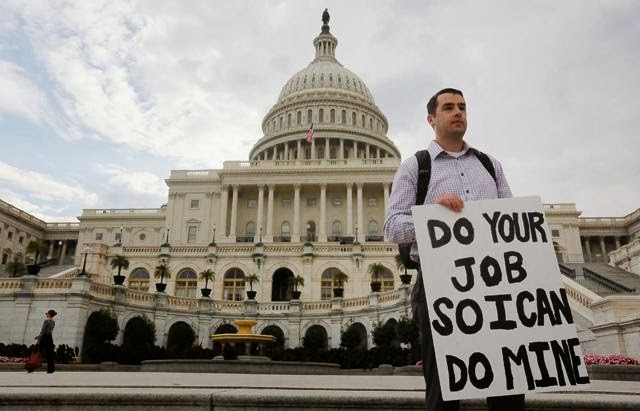
I talked about the new reality we face as practitioners in yesterday's post, the world where more frequent and stronger weather-related events impact greater numbers people than ever before. Well a new wrinkle has been added to our unique operating environment--a partial government shutdown. The impacts of this shutdown will take time to fully understand, but I've read a lot of conflicting reports about what this means exactly to community response and recovery.
Source: Larry Downing/Reuters
FEMA
There's a worry about whether FEMA-related programming will continue, and the answer is, yes they will i.e. Individual Assistance and Community Development Block Grants (CDBG). And according to Dan Watson, a spokesman for FEMA:
“There are more than 1,000 FEMA workers on the ground in Colorado responding to the floods. They are not being impacted by the shutdown."
So there will be the administrative personnel to ensure that the recovery machine keeps moving. This brings a sigh of relief to the residents in Colorado who are beginning to understand the impact the floodwaters had. Colorado State government on the other had will spend between $40-$80,000/day keeping 120 National Guardsmen focused on the rehabilitation of critical infrastructure that would otherwise have stopped.

However, for the city of Moore, OK the shutdown looks like it could delay a 4 Million dollar reimbursement check FEMA needs to cut for reimbursing cleanup costs. And for those on the east coast, the shutdown looks like it will slow down the dispersement of available grant funds fueling long term recovery. Even though money has been allocated for Sandy Relief, there's the problem with staffing. For instance, of the 749 employees in HUD's Community Planning and Development office which handles grants to cities and states for recovery, only 13 employees will go to work everyday during the shutdown. Long Term Recovery is a slow process to begin with when fully staffed and all the kinks worked out, I believe the reduction in staffing will have a ripple effect that will be felt for months to come and work against the gains made in advancing recovery in communities impacted by Sandy.

Because funding for long term recovery comes from a diverse range of federal entities, making exceptions to keep people working in the various agencies on behalf of impacted communities during the shutdown would've required a herculean effort that did not materialize. It seems that disaster specific dollars are available, the question that remains is whether or not there are enough people to provide the oversight needed to keep things moving.

Environmental Protection Agency
You can't have disasters without some sort of environmental impact, which is why the EPA plays a critical role in helping to define what that impact is and how best to address it.

The EPA states that those who are engaged in activities that:

"ensure continued public health and safety, including safe use of food and drugs and safe use of hazardous materials; those who protect federal lands, buildings, equipment and research property; those who conduct law enforcement and criminal investigations; and those who provide emergency and disaster assistance" will continue working.
While good to know, it remains unclear at this time as to whether or not the work the EPA was doing in Colorado to define the extent of the potential environmental impacts the floodwaters had on the Fracking wells continues or not. With 94% of the EPA's employees not working and reports that the amount of oil spilled as a result of the flooding has topped 40,000 gallons, I sincerely hope that the EPA has boots on the ground. 

I don't know about you, but I'm not overcome with a sense of calm, I guess it's because I keep thinking about what would happen should another event take place? Say a major hurricane makes landfall, would FEMA be able to deploy resources? In theory, I imagine they would because the funds used to implement PA/IA programming come from the Disaster Relief Fund; however, actually implementing those programs may be impossible due to furloughed personnel. 

Partial or total, a shutdown of our government will have serious ramifications that impact communities recovering from disasters--I hope that common ground can be found so the business of helping communities recover can begin in earnest once again.

Monday, September 30, 2013

Could this be the worst hurricane season on record?

You feel that? It's getting a little chilly outside, especially if you're in the northeast. The leaves are just beginning to change and it's officially fall. As people put their thoughts of a possible Indian summer to bed and takeout their jackets and boots, they also generally think that they've dodged a bullet when it comes to Hurricane season.

Now you might be laughing to yourself saying that I'm a moron! Don't you remember Hurricane Sandy? How can you say that people have put those thoughts to bed when the Anniversary is right around the corner--at the END of October? And that Hurricane season doesn't end until the END of November? And you'd be right, all of those things are true save for the moron part; we still have a lot of Hurricane season to anxiously wait through and there's a lot of media reminding us of that fact:
  • http://www.cnn.com/2013/09/14/us/hurricane-season-prediction-mystery/index.html
  • http://www.climate.gov/news-features/event-tracker/does-august-lull-atlantic-hurricane-activity-mean-we-wont-be-having
  • http://www.eqecat.com/blog/hurricanes/atlantic-hurricane-season-forecast-august-2013/
  • http://science.time.com/2013/09/09/a-silent-hurricane-season-ignites-a-debate-over-global-warming/
  • http://www.usatoday.com/story/weather/2013/09/07/quiet-hurricane-season/2776845/
When you read through these articles asking what's going on, you can almost sense that they're pissed, an almost "What Gives?" attitude; you promised us an above average hurricane season...remember?" 


NOAA: Atlantic hurricane season on track to be above-normal


Yet here we sit...waiting, wondering, silently cursing the powers that forecast our fate...and we do this because we can't do anything else. 

So, how can I say that this may be the worst hurricane season on record if nothing has happened yet? Well, it was a tad dramatic to say "the worst" but it's pretty bad. Remember the heeded warnings that preceded Hurricane Irene? Shutdown subways, runs on food, and people getting out of town? It was a major inconvenience, but people did it. When Irene fell short of producing forecasted impacts, people felt lied to and the city took a hit financially from cancelled events and shuttered infrastructure. From a preparedness perspective it was a huge win though, the city was prepared for a potential storm and pulled through relatively unscathed. What happened though was that it eroded the confidence in the forecasting models and in the decision-makers who urged people get ready...because nothing happened.

Fast forward to Sandy coming up the eastern seaboard a year later and a similar situation unfolded. Warnings were communicated, subways were shuttered, and on the barrier islands evacuation notices were issued. However, because people felt burned by the false alarm that was Irene, those warnings fell on deaf ears--a, 'fool me once shame on you, fool me twice shame on me' mentality.

So in saying that this is potentially the "worst" hurricane season on record is due to the potentially damaging ramifications from a psychological perspective. People have short memories when it comes to disasters, a sort of disaster amnesia. Right now hurricane season has the attention of many more people than it would otherwise, with the proverbial preparedness pump primed for people to exercise plans made in preparation of, or in response to Sandy. If nothing happens this season, that would be fantastic, but I believe that the amnesia will begin to set in and the focus on individual, family, and small business preparedness will fade into the ether--which is not so fantastic.

Getting people to take notice of preparedness activities and integrate them into their lives is one of the greatest challenges we face as practitioners. It's unfortunate that it takes an event where loss of life and property occur for people to take notice and more importantly, take action. It's an even more unfortunate that the action it fuels is so short-lived. Without a constant reminder of why being prepared is so important, people forget, because it's easier and less overwhelming to let it slip away than to remain vigilant.

For those who are still in the process of recovery in the mid-Atlantic region, Sandy is not a distant memory but an everyday reality. The luxury of letting what happened slip away is not a possibility, so while the limited physical impacts of a quiet hurricane season are wonderful, the psychological toll it takes on how people view preparedness can make the quiet years some of the most damaging.  

Friday, August 30, 2013

Social media and Calgary Flooding

The hashtag #SMEM (social media emergency management) is flourishing on twitter. I've mentioned VOSTs (virtual operation support teams) that have formed in response to the need for remote support in communities overwhelmed due to infrastructure and personnel limitations. I've talked about the proliferation of technologies that organizations are utilizing and the questionable impacts they're having on nonprofit response, but I haven't talked about Canada. Canada got sucker punched earlier this year by unforeseen flooding, a north-of-the-boarder Sandy if you will. Well just as everyone went agog over the social media stats for Sandy here is the first consolidated dataset on social media use during the flooding in Calgary.

Social media and its ability to empower an organized voluntary response is no longer debatable...it's time we re-wrote some volunteer management annexes and figured out how to truly integrate local response (grassroots efforts) into the broader context of emergency management.

Thanks to Inbound Interactive for putting this together...
calgary-social-flood-infographic

Friday, June 14, 2013

The Good for Nothing Club*

 
Civic Engagement: Community Disaster Relief Wagon from Lori H. Ersolmaz on Vimeo.

The reason I posted this video is because it captures the spirit of so many people who just start helping after a disaster...whether it's flying across the country and renting a U-Haul to create a mobile kitchen, or helping someone cleanup their home, the power of people helping people is pretty amazing.

The other reason I posted it is because I think this video captures the sentiment of a lot of Spontaneous Unaffiliated Volunteers (SUVs) and their motivations for getting involved, which I believe is an important first step in being able to setup systems that work with this type of mentality. Better understanding the motivations of SUVs will help to create dynamic and flexible systems of coordination that support these types of individuals on a local level, while working to integrate them into the broader response context instead of ignoring or marginalizing them and their impacts.

Have a good weekend...see you on Monday.

* The good for nothing club, people who do "good" for "nothing." Kinda corny...but I like it.