Showing posts with label funding. Show all posts

Wednesday, October 2, 2013

Govt shutdown and disaster response

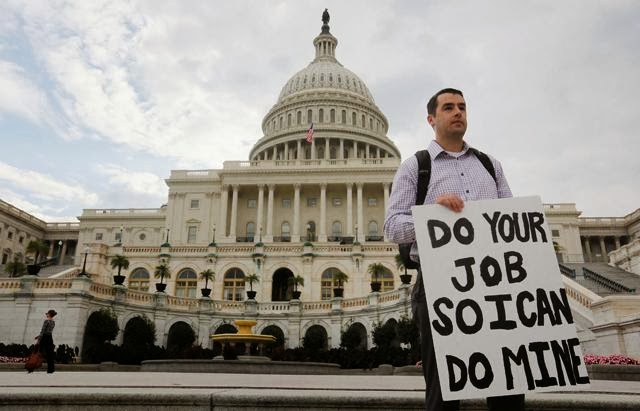
I talked about the new reality we face as practitioners in yesterday's post, the world where more frequent and stronger weather-related events impact greater numbers people than ever before. Well a new wrinkle has been added to our unique operating environment--a partial government shutdown. The impacts of this shutdown will take time to fully understand, but I've read a lot of conflicting reports about what this means exactly to community response and recovery.
Source: Larry Downing/Reuters
FEMA
There's a worry about whether FEMA-related programming will continue, and the answer is, yes they will i.e. Individual Assistance and Community Development Block Grants (CDBG). And according to Dan Watson, a spokesman for FEMA:
“There are more than 1,000 FEMA workers on the ground in Colorado responding to the floods. They are not being impacted by the shutdown."
So there will be the administrative personnel to ensure that the recovery machine keeps moving. This brings a sigh of relief to the residents in Colorado who are beginning to understand the impact the floodwaters had. Colorado State government on the other had will spend between $40-$80,000/day keeping 120 National Guardsmen focused on the rehabilitation of critical infrastructure that would otherwise have stopped.

However, for the city of Moore, OK the shutdown looks like it could delay a 4 Million dollar reimbursement check FEMA needs to cut for reimbursing cleanup costs. And for those on the east coast, the shutdown looks like it will slow down the dispersement of available grant funds fueling long term recovery. Even though money has been allocated for Sandy Relief, there's the problem with staffing. For instance, of the 749 employees in HUD's Community Planning and Development office which handles grants to cities and states for recovery, only 13 employees will go to work everyday during the shutdown. Long Term Recovery is a slow process to begin with when fully staffed and all the kinks worked out, I believe the reduction in staffing will have a ripple effect that will be felt for months to come and work against the gains made in advancing recovery in communities impacted by Sandy.

Because funding for long term recovery comes from a diverse range of federal entities, making exceptions to keep people working in the various agencies on behalf of impacted communities during the shutdown would've required a herculean effort that did not materialize. It seems that disaster specific dollars are available, the question that remains is whether or not there are enough people to provide the oversight needed to keep things moving.

Environmental Protection Agency
You can't have disasters without some sort of environmental impact, which is why the EPA plays a critical role in helping to define what that impact is and how best to address it.

The EPA states that those who are engaged in activities that:

"ensure continued public health and safety, including safe use of food and drugs and safe use of hazardous materials; those who protect federal lands, buildings, equipment and research property; those who conduct law enforcement and criminal investigations; and those who provide emergency and disaster assistance" will continue working.
While good to know, it remains unclear at this time as to whether or not the work the EPA was doing in Colorado to define the extent of the potential environmental impacts the floodwaters had on the Fracking wells continues or not. With 94% of the EPA's employees not working and reports that the amount of oil spilled as a result of the flooding has topped 40,000 gallons, I sincerely hope that the EPA has boots on the ground. 

I don't know about you, but I'm not overcome with a sense of calm, I guess it's because I keep thinking about what would happen should another event take place? Say a major hurricane makes landfall, would FEMA be able to deploy resources? In theory, I imagine they would because the funds used to implement PA/IA programming come from the Disaster Relief Fund; however, actually implementing those programs may be impossible due to furloughed personnel. 

Partial or total, a shutdown of our government will have serious ramifications that impact communities recovering from disasters--I hope that common ground can be found so the business of helping communities recover can begin in earnest once again.

Wednesday, June 26, 2013

Funding Disaster Preparedness and Community Resilience

I recently posted about the Rockefeller Foundation and their move to create a $100 Million Preparedness fund, something that will hopefully change the mindsets of how private donors and foundations view the funding of disaster-related initiatives.  

Any opportunity to challenge traditional funding mindsets is important and I believe by Rockefeller establishing this fund, the current funding trickle that disaster organizations fight over can turn into a steady flow for disaster-related operations and programming. While establishing consistent access to funding is key, I believe there may be a larger opportunity connected to what Rockefeller is doing; I believe there may be an opportunity to leverage this fund, or the idea that spurred the creation of this fund, in a way that can work to create an environment of accountability in reporting, coordination, and the creation of standards to improve the unity of effort around preparedness and community resilience.

Challenge
The current landscape for disaster funding comes as a reaction to events and as such is based around a shorter-term view of how to measure impact. A great number of donors have their own ideas of what “success” is as it relates to preparedness, response, and recovery, with little overlap existing between those ideas. This diversity makes generating consensus around standards in any facet of the disaster life cycle difficult because everyone is beholden to different funders—for many of whom disaster response is not a part of their mission / mandate.

With the push for broader inclusion around the ideas of resilience and preparedness at a local level, and the money to back it predominately coming through state agencies to local/county Emergency Management Agencies (EMA), there is little room to support those at the ground level through education and planning to further the ideas of resilience beyond its current state.

Opportunity
As a philanthropic leader, The Rockefeller Foundation can as part of its existing preparedness fund, or with the creation of a separate fund, begin to implement a standards-based grant program that offers money for preparedness and resilience focused initiatives. In exchange for accepting funding, community based organizations would have to adopt an operational framework and common standards that relate to disasters that scale to meet needs, and can be easily replicated. Sounds easy, right? We know money is a means to an end, and we’ve seen the success of this funding model with the dollars flowing from the Federal government to City, County, and State EMA. As long as NIMS/ICS compliance is maintained, State Agencies remain eligible for Federal dollars, which is what a large percentage of their operational budgets are derived from.

The result is consistency in action across City, County, and State EMA, something that hasn’t been possible in the non-profit world. The reason why there is uniformity of effort and a greater consistency in language amongst the federal family is because of the strings attached to available dollars requiring compliance with NIMS/ICS.

I believe The Rockefeller Foundation can be the financial muscle that gets the ball rolling for a similar initiative amongst disaster response and community resilience focused non-profits. With the help of IAEM, CNCS, NVOAD, FEMA and other leaders in the sector, the creation of a commonly accepted framework for the preparedness and response can be built with a financial incentive for adopting it.

Monday, June 24, 2013

$1.4 Million dollar grant to Presbyterians for Volunteer Housing?!?!

Please read this press release found on Disaster News first to get background so that we start on the same page.

Now, please forgive the incredulity as I know what it takes to find housing for 50+ volunteers in disaster areas during immediate response, it's not easy, and even when it does work, there are always problems. But when learning about the grant from the Red Cross to Presbyterian Disaster Assistance (PDA) for $1.4 million dollars to "setup and coordinate volunteer housing" my jaw dropped.

Before I get into it, if anyone has any additional information on the details of this grant and would like to share them...please do, because it's in the details that I hope an explanation can be found. In going to the PDA site, you need to search to find any mention of it and in the world of disaster response this is a big deal...so what gives, where's the pomp and circumstance?

In the immediate aftermath of a disaster the need for housing is great, for displaced families, for first responders from outside the immediate area, for Federal officials, and also for Volunteers groups. Depending on the size/scope/type of disaster, the availability or lack thereof of housing can create a panic. This could be seen in the New York metro area following Sandy where housing was scarce and the need was great, and the influx of people overwhelmed what little was available. I spent several weeks knocking on doors before finding suitable space on Staten Island and on Long Beach on Long Island. All that to say, I understand what goes into setting up volunteer housing.

The reason why my jaw dropped is because setting up volunteer housing for 50+ people had a price tag closer to $1-2,000 mostly spent on infrastructure improvements: showers, shelving, secure storage, etc...and PDA now has $1.4 million?

To better understand how PDA does Volunteer housing, I found this document that outlines their Volunteer Village model. In the document you will see that the individuals responsible for running these villages are volunteers, so there is no cost for personnel to run the sites. In addition, there is a $20/person/night charge for staying on-site, presumably to cover utilities and upkeep. In addition to that, these villages don't take individuals...so it's not a holistic volunteer housing solution because it doesn't accommodate Individual Volunteers who need a place to sleep.

So what exactly is PDA going to do with $1.4 Million dollars? Even if they setup 100 volunteer housing sites in the mid-atlantic region, as far as I understand it, they are a cost neutral proposition. Even if PDA took between 5-10% and used it for admin/salaries...there's still well over $1 Million to spend on this and I just don't see how.

I would love to see what the plan is, how many sites will be setup, when, and for how long? How many Volunteers are to be housed under the terms of the grant? Where is this money going exactly? How do Long Term Recovery Groups feel about this in the Mid-Atlantic region? Is PDA a pro-bono subcontractor now?

A lot of questions come to mind and I'm short on answers. I realize I'm owed nothing, but a greater degree of transparency would be helpful especially as articles are beginning to pop up asking where, why, or why not Sandy Recovery funds have been spent...and this massive grant, a first of its kind if I'm not mistaken, is flying under the radar.

Tuesday, June 18, 2013

CRO -- Chief Resilience Officer


In a move that hopefully signifies a change in how foundations and donors view funding disaster initiatives, the Rockefeller Foundation is blazing a path forward with the creation of a $100 Million Dollar Global Disaster Preparedness Fund. At the center of the fund is the "100 Resilient Cities Centennial Challenge," a global grant program that essentially works to incentivize the integration of resilience into urban and disaster planning. Those who win a grant award will receive funding for a "Chief Resilience Officer," an individual who will be responsible for oversight and implementation of the city's master recovery plan.


Beyond the initial PR splash, there are few details on the application / nomination process at this time, but will be something I watch for updates on given the questions an initiative of this nature raises. Since many cities already have robust preparedness plans in place, seeing how this position will integrate with those existing plans and where the position will sit within the Emergency Management hierarchy could be telling of how effective it will be. Will this position create another layer of planning and procedural bureaucracy that cities have to wade through, or will the Resilience Officer have the authority to begin to make sweeping changes to how cities define and enact resilience in the face of disasters? While much of the authority will most likely be derived from how and where the dollars are to be spent, it will be interesting to learn how the position is to be integrated in with the existing HR frameworks.

While I imagine cities are excited at the prospect of supplemental dollars in their preparedness coffers in light of dwindling federal money to support their efforts, non-profits should be equally excited or at the very least encouraged by this move. The quest for consistent funding for disaster-focused non-profits is all consuming and the results are often weak given the reluctance of foundations (public and private) to fund response activities...let alone general ops to keep the doors open.

The reason the creation of this fund with Rockefeller backing is so important, is because of the momentum and acceptance it will hopefully generate throughout the donor community when approached with opportunities to fund disaster initiatives. For the same reasons no one likes to go first for anything are the same reasons no one wants to be the first to fund something new.  

I'm hopeful that with the creation of this $100 million fund and the coverage it will generate, that mindsets will shift and the foundation world will recognize the importance of funding non-profit disaster-related initiatives associated with preparedness/response/recovery.

Shifts in mindsets move at a glacial pace when dollars aren't involved and a move of the type I would like to see happen would entail a lot of money, as a result, I don't see any radical changes happening anytime soon…but the creation of this fund is the first step in the right direction.