Showing posts with label coordination. Show all posts

Tuesday, November 19, 2013

International Disaster Response is a cluster...

The Philippines, an archipelago comprised of 7,000+ islands, is a paradise where the warmth and friendliness of the Filipino people make it a top travel destination. When Yolanda mowed her way across the island chain and it became apparent that it was going to be an event requiring significant humanitarian response, aid organizations put out appeals for donations and sent in assessment teams to figure out how best to provide their special brand of assistance.

With the overwhelming need created by the Typhoon, coordinated response remains a top priority. But how do you coordinate that many moving parts? In the U.S., coordination is a consistent challenge faced by federal, state, local, and community-based response structures. Internationally, aid organizations, foreign and domestic military assistance, and agencies representing the alphabet soup of UN agencies also need to be taken into account on top of everything else. With millions affected, thousands dead, and hundreds of thousands of homes damaged or destroyed across multiple island communities, where do you begin, how do you begin, and who's in charge?

The international humanitarian aid community has something that we in the United States do not--something that helps alleviate a lot of the guesswork around how the response will be shaped so that the focus can be on the provision of aid to those in need. On the premise of improving humanitarian response in emergencies, the United Nations (UN) created the IASC (the InterAgency Standing Committee), and in 2005 the Cluster System for coordination in humanitarian emergencies was adopted. The cluster system provides a scalable and replicable way for handling the delicate dance of leadership and coordination based around functional needs in response operations.

Cluster Overview


The thematic focus of the cluster system alleviates confusion around roles and responsibilities and makes it easier to highlight competency within a specific response function. While clusters aid in the dissemination and consumption of operational data, they also create unique funding opportunities. Because of the way the cluster system is structured, pooled funds managed by the UN are available to help support humanitarian operations and are oftentimes granted through the cluster system:
Because complex humanitarian emergencies require so many aid organizations working together, a system to coordinate their activities is needed without limiting their independence. The Cluster System, for any faults it may have, is a system that has the buy-in needed and the ability to fill the most critical of role's--coordination that enables a stronger and more cohesive response.

While every system has its proponents and detractors, the fact that there's a unified system to point to is a big accomplishment. Domestically, emergency support functions (ESFs) would be the mechanism that plays a role most similar to that of the clusters, but unfortunately I think that the cluster system succeeds in combining the focus of ESFs with the coordinative function of a VOAD.

Coordination will always present a challenge to governments, municipalities, donors, and any other moving component involved in the disaster response machine. For whatever faults it may have, I applaud the IASC for endorsing the cluster system and for the organizations who operate within it's framework...I look forward to seeing all the good it can do in expediting a coordinated response to the communities struggling in the aftermath of Yolanda.

Monday, September 16, 2013

Coordinating Cleanup 1.0

Crisis Cleanup has a great logo
Nonprofits setting up operations in Colorado are abuzz with talk of Crisis Cleanup, the brain child of Aaron Titus, a guy who said "there's got to be a better way to organize some of the chaos of early recovery cleanup" (I made that quote up) and created a tool that's doing just that. He created a tool that works to advance how nonprofit organizations engage in cleanup activities following a disaster.

The cliff's notes version is that Crisis Cleanup is a google map populated with cleanup needs represented by pins dropped on the location of said need. Registered organizations can claim pins so that other responding groups don't accidentally send teams to a home that has already received help. There is a reporting aspect that accompanies this so that hours can be tracked and volunteer numbers logged, an innovative solution that helps manage the nonprofit aspect of early recovery cleanup following disasters.

I had an opportunity to be a user of the system after Hurricane Sandy as part of its beta testing during response and saw the potential. Since then the system has been implemented several times with what I hope are fixes and advances making it easier to use and more comprehensive from a data capture perspective.

Screen shot of the user interface -- Superstorm Sandy
With the system being used in Colorado to coordinate nonprofit cleanup activities, I'm interested in hearing from anyone who uses it to manage their infield work flow to get your thoughts on the system within the context of cleanup coordination.

And while I'm optimistic about how Crisis Cleanup can work to provide the autonomy nonprofits seek while working within a defined system, I feel that it's important to remember the need to be inclusive.

Spontaneous response in disaster and the substantial impact it has during early recovery activities is no longer an ignorable trend. Social media is being used to organize armies of volunteers to aid in response and recovery, and it's happening as I write this in Colorado. As a community of practice we must strive to include as many of these emergent groups as possible in response coordination. Not only is it key in working towards enacting the "all of nation" or "whole of community" approach to preparedness and response as outlined by Presidential Policy Directive 8, but its important for unity of effort to provide better coordinated service delivery to those affected.

As it stands the crisis cleanup tool is largely for vetted organizations, those with a response history or those who are "known" entities. And while I understand why the system is setup this way, to help ensure consistency in the work done on behalf of homeowners, I feel that there is a solution that can set an expectation as to the level of work needing to be done, while encouraging broader inclusion of locally responding groups.

All Disasters Are Local, a tired expression but one that holds truth; and while Crisis Cleanup has taken a monumental step in unifying early recovery cleanup from a nonprofit perspective, I believe that there is work to be done to ensure access to this tool makes its way down to the emergent groups on a local level. For it's those groups that have the biggest stake in ensuring that their communities make a full recovery and as such rightfully deserve to be included within the broader coordinated effort.

A tip of my cap to you Mr. Titus, I look forward to seeing how we can evolve the model moving forward.

Friday, August 30, 2013

Social media and Calgary Flooding

The hashtag #SMEM (social media emergency management) is flourishing on twitter. I've mentioned VOSTs (virtual operation support teams) that have formed in response to the need for remote support in communities overwhelmed due to infrastructure and personnel limitations. I've talked about the proliferation of technologies that organizations are utilizing and the questionable impacts they're having on nonprofit response, but I haven't talked about Canada. Canada got sucker punched earlier this year by unforeseen flooding, a north-of-the-boarder Sandy if you will. Well just as everyone went agog over the social media stats for Sandy here is the first consolidated dataset on social media use during the flooding in Calgary.

Social media and its ability to empower an organized voluntary response is no longer debatable...it's time we re-wrote some volunteer management annexes and figured out how to truly integrate local response (grassroots efforts) into the broader context of emergency management.

Thanks to Inbound Interactive for putting this together...
calgary-social-flood-infographic

Tuesday, July 2, 2013

We Can't do it Alone = We Need a Plan

I came across this post on Bill Driscoll Jr.'s tumblr blog recently and it communicates the need for unified approach to how non-profits engage in disaster work. Bill is the Executive Director of Nechama, The Jewish Response to Disaster...I encourage you to give it a read:


Longform: We Can’t do it Alone = We Need a Plan

http://billdriscolljr.tumblr.com/ 
The reality of disaster recovery is that no one person, government agency, or voluntary organization can do it alone. This staggering and sobering realization for survivors and responders alike, comes consistently post disaster.
Recently the concern and potential complications created by the threat of augmenting Federal disaster funds had been consistently in news. Federal budget negotiations seemed to be fixated around disaster recovery dollars. While Federal support can be critical to disaster recovery for both individuals and municipalities, many disasters in the United States go “undeclared”, meaning that they are smaller in size and do not meet the criteria for a Presidential declaration and the accompanying Federal support. We do know the answer to the questions “what if FEMA support isn’t available?” and “what would the recovery look like?”
When a disaster goes “undeclared” and does not generate a Presidential declaration, the burden of recovery falls on individuals themselves, any insurance settlement, available state programs and available charitable or voluntary organization support.  That said, even in a Federally declared disaster area, non governmental organizations (NGOs) and community based organizations, faith based or not, still provide many of the missing pieces of a disaster survivor’s recovery.  FEMA’s own “sequence of delivery” literally begins and ends with voluntary agencies. [See herehttp://www.fema.gov/pdf/about/regions/regioni/sequence2008.pdf]
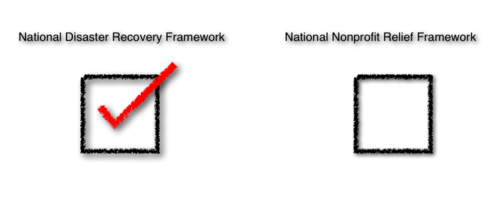
Amidst the recent budget posturing in Congress, FEMA released the National Disaster Recovery Framework (NDRF), which details “the plan” for future Federal support to state recovery operations. A clearer and updated national plan for the delivery of government related disaster recovery operations is a welcome and important addition to the disaster response and recovery community. That said, no sooner than we can pat those on the back that participated in and crafted the NDRF do we need to focus on what still lacks within this dedicated and passionate community (Full disclosure: I participated in a stakeholders session). The disaster recovery community is comprised of not only government responders but an inspired lot of nonprofit and faith based NGOs.
There is no equivalent to the NDRF for the NGOs active in disaster work and yet this is the part of the community that most consistently engages to help survivors post disaster. The needs that are generated by disaster (even those that do not receive official Federal designation) compel most NGO operations to action, many of which are volunteer and donor driven.
For me, someone that is engaged in disaster response and recovery on a daily basis in the charitable and nonprofit sector, the lack of a consistent field-wide plan or framework is apparent at every disaster event I deploy to. There continues to be lack of consistently agreed upon or valuable structure for NGO coordination both from a distance and on the ground. I believe focusing on an NGO-centric complimentary plan to the National Disaster Recovery Framework needs to be a top priority for the entire disaster response and recovery community. The discussion, research and development of  a “parallel” plan began a few years ago but the process to create what is known as the  “National Nonprofit Relief Framework” has been stuck in neutral. Its originally targeted release date of December 2010 has come and gone. The BP oil spill in 2010 and 2011’s six months of what seemed like nonstop tornadoes, floods, and tropical storms have played a major role in the stall. We as a community have been quite busy…
Many NGOs that are national in scope and have disaster related programs are members of coalitions like National Voluntary Organizations Active (National VOAD) in the hopes that greater communication will lead to collaborative partnerships. National VOAD and the numerous related state level forums are fantastic and beneficial but they are by design, right or wrong, not operational in nature. The members’ relationships and values within the National VOAD community, however, can and will help spawn a renewed effort for a nonprofit relief / recovery framework. Tremendous amounts of aid and hope are delivered by a diverse group of VOAD and NGO partners at each disaster. The potential to do more by strategically pooling resources under the framework of a tactically coordinated plan will only serve to grow the efficiency and effectiveness of our already impressive community. The potential growth is exciting. 
I hope the NDRF completion brings new light and enthusiasm to complete, “whole community” planning through renewed focus on the means by which nonprofits and NGOs collaborate in disasters alongside resources brought to bear by Federal down to local level government.
As expressed by the outpouring of charitable giving by donors following tragedy and disaster, we collectively seem to understand the norm that donated dollars are different than Federal ones and can be utilized and dispersed for varied and perhaps no less effective reasons. Simply no one agency whether or public or private can do it alone. As such we should be constantly driving toward enhancing and improving the way we coordinate and collaborate pre and post disaster.
We in nonprofits are at the mercy of proving that donations are being spent effectively and efficiently.  In order to improve our current collective measures we should move with vigor toward a comprehensive and consistent recovery coordination framework so we are better prepared the next time disaster strikes our country.

Tuesday, June 4, 2013

Volunteers in Disasters

The impact of non-profits, or more specifically, VOADs (Voluntary Organizations Active in Disaster) and their role in expediting a community’s recovery by leveraging their proficiency in the response/recovery time frame is undeniable; their depth of experience and breadth of resource can be the difference between weeks and months of recovery time. Oftentimes those resources brought to bear are volunteer-based.

However, not all of the resources brought to bear come in an organized fashion. Overwhelmingly compelled by the desire to do something, individuals and groups show up in droves with no previous response experience and jump in, these individuals are called Spontaneous Unaffiliated Volunteers (SUVs) and they continually challenge those responsible for volunteer coordination and management during response and recovery.


This influx of individuals wanting to help is well documented, so much so that guides have been created to help responding communities deal with the surge: "Managing Spontaneous Volunteers In Times of Disaster: The synergy of Structure and Good Intentions," but even with the historical data foreshadowing the surge, leveraging this pool of energy and desire to help continues to challenge those of us in response.

As someone who got their start and discovered their passion through volunteering, listening / reading to this news story gave me pause: "In the Face of Disaster, Certification Makes The Difference." The longstanding line from the response community to the world at large has been to pre-affiliate, get trained so that you can confidently and productively put that training to use after the next disaster strikes. With the understanding that all volunteers come with needs: food, housing, and productive work in a community, coupled with the shift that's taking place in how volunteers organize following disasters, the pre-affiliate message to me seems stale.

In the report it states: 
"Volunteers are always appreciated, but it's the certified ones that make the real difference."
I guess I'm unclear about what making a real difference means. Don't get me wrong, I believe that as many people who can align themselves with an organization prior to a disaster, the better. But to say that those who don't pre-affiliate but deploy anyway don't make a "real" difference does a disservice to the time, dedication, heart, and often tears that are shed as those SUV's help homeowners cleanup following an event.

The challenges associated with volunteers following a disaster are not black and white, there are liability issues, safety issues, logistical and coordination issues, reporting issues, etc...and because every jurisdiction seems to work from a slightly different playbook trying to address them or create standards to mitigate their impacts becomes exceedingly difficult. 

With the 'whole of community' and 'community resilience' rhetoric being pushed from a federal level, coupled with the local movement that's taking root in communities following disasters, the time is now to have a real conversation about changing views on SUVs and learning from their substantial impacts. Groups like: Occupy Sandy, Staten Island Strong, Respond and Rebuild, Rockaway Help, Southeast Nashville Flood Recovery, opokrelief are great places to start that dialogue.

As someone who began their career in disaster response and recovery as a SUV, the pejorative view that continues to pervade the response community regarding SUVs is something that I believe continues to limit the speed and cohesion of response efforts. There is no doubt that VOAD groups make a considerable impact in mass care activities, but as technology continues to increase connectivity and social platforms make the dissemination of needs easier and faster, a rethinking of how to better incorporate local groups, comprised almost entirely of SUVs, will have to be addressed to ensure that the 'whole of community' is being engaged in response activities.  

Thursday, May 30, 2013

The proof is in the analytics and sweet infographic

While saying: "Social Media is a big deal and we need to start paying attention," it's interesting to see statistical data gleaned from the real world to back it up.

In addition to the below infographic (compliments of USF's MPA program), Patrick Meier posted a breakdown of the 2.1 million tweets in the first 48 hours after the Moore tornado...providing data that will reaffirm your burgeoning love affair with social platforms.

University of San Francisco Online Master of Public Administration