Showing posts with label disaster preparedness. Show all posts

Thursday, February 6, 2014

Marketing Preparedness...

How do you break through? How do you create messaging that resonates? How do you get people to care, to act, to change their behavior? These questions can be heard in the offices of marketers and advertising...but they can also be applied when considering how to market preparedness.

The challenges in creating awareness and ultimately action around preparedness messaging feels very similar to the challenges advertisers and marketers face when changing perceptions or introducing a brand. Creating value around an idea, or inspiring action can be a daunting task, especially when we're talking about subject matter that makes people uncomfortable. The ability to raise awareness while actually imparting knowledge or changing behavior is the end goal in both marketing and preparedness, so why isn't there more cross pollination done between the two disciplines?

Meet Jenny Gottstein, she is one of those people who is blurring the lines between preparedness, marketing...and dare I say something that sounds like fun?!

At preparedness events there is usually a long line of people coming for free stuff, and during the 15 seconds you have their "attention" you try to impart some wisdom that may help them in the event of a disaster. These types of events are more about moving product to make reporting look good than it is about changing attitudes and perceptions.

Urban scavenger hunts are a big deal thanks to shows like "The Amazing Race;" clues direct you to various point and challenges dictate how quickly you advance and it appears Ms. Gottstein has combined the two, and thrown our love affair with Zombie's in the mix. The result is a disaster preparedness training game under the guise of the Zombie Apocalypse.
Soucre: Thelocalvoice.net
She armed players with smart phones and Nerf guns, and had teams of people run around the San Francisco completing challenges like "light a BBQ without matches" or “pack a Go Bag” or "bandage a burn wound" all while being chased by zombies. She tried to incorporate practical skill building but in a way that is more fun than serious. There was a lot of coverage of the event as well, on sites like: SF Weekly, FunCheap SF, and 7x7 and from the looks of it, it was well attended and fun was had.

According to Ms. Gottstein "It was a huge success" and as a result she is working to develop this concept into a nation-wide phenomenon.

I like this concept because it takes everything that I've talked about and we as a community of practice talk about and is actually trying to do something with it. Of course it's easy to be negative about how it doesn't do this, or meet the standards of that...but what it is doing, is getting communities of young people engaged. By leveraging popular culture and tying it to concepts that we struggle to connect to people on, she may have found a way to make people care, which I believe is a huge step in the right direction.
source: millenialtrain.co
Ms. Gottstein is working to create a version 2.0 and has applied to board Millennial Trains Project, a cross country start up incubator-esque environment on a train that stops in several cities along the way.

She has raised $5,000 and I believe secured her seat which is great news because she plans on meeting with some interesting people to build her ideas to adapt the game and make it better.
The Little Things Lab
Univ. of New Mexico Game Design Students
Code for America
Create Here

I encourage you to check out her page at: http://crowdhitch.millennialtrain.co/campaign/detail/2481

Make a plan, build a kit, get engaged...and get attacked by zombie's adds a new dimension to a marketing message that many have tuned out. In order to communicate with the whole community, we have to revise the way we approach how we engage. I think what Ms. Gottstein is trying to do is different, fun, and allows people to interact with the concepts of preparedness...something I haven't too much of in preparedness programming up to this point.

What do you think? Do you have examples of unique or innovative preparedness programming?

Thursday, January 30, 2014

To declare, or not declare...that is the question...

Washington, IL November Tornado Source: imugr
While never having had the responsibility of sitting in a County Executive's position or position of even greater responsibility at the state level, I would imagine that when a disaster strikes, they are conflicted: on the one hand they worry about the safety of their constituents, and on the other, they want the event to cause enough damage so that their jurisdiction can qualify for federal assistance. In a time when cities are declaring bankruptcy and tax bases are eroding, elected officials have to navigate the emotional fallout of a disaster as well as figure out how to pay for the subsequent response and recovery.

Although the disasters of 2013 didn't have the gravitational pull that Superstorm Sandy had, the Oklahoma Tornadoes, The Rim Fire in California, and the Colorado flooding all caused significant damage and all received Major Disaster Declarations.

However, 2013 also had several events that didn't qualify for Individual and/or Public Assistance, adding new voices and national coverage to growing discontent on how exactly the declaration process works. While some sort of declarations were given to the Yarnell Fire in AZ, The Fertilizer Plant explosion in TX, and the November Tornado outbreak in Illinois, in each instance there was an outcry that more should have been done to support the communities and survivors of those events.


Even though the above events didn't meet designated thresholds that would have triggered the full breadth of federal assistance, a Bill (H.R. 3295) was introduced in the House of Representatives with the intent of amending the criteria under which resources are offered dubbed the: "Fairness in Federal Disaster Declarations Act of 2014."

This Bill, which was introduced on January 21st, would amend the criteria used to evaluate a request for a major disaster declaration by weighting the factors used to determine Individual and Public Assistance, as well as request that economic factors of the impacted locality and the state's financial situation be taken into account when determining eligibility.

When the Congressional Act of 1803 was passed, considered the first piece of disaster legislation, it provided assistance to Portsmouth New Hampshire, a town recovering from a major fire. Prior to that localities were left to fend for themselves in the wake of a diaster. The premise on which our Emergency Management infrastructure is based is that events are to be handled at the lowest level of government possible. By amending the rules on how federal assistance is meted out, would we be making more events eligible? Would it work against the goals of creating resilience and bolstering preparedness in communities? Would the Bill ultimately end up paying for deferred infrastructure improvements? Not only that, but who's paying for the additional dollars given to disaster survivors?

While the current criteria used to trigger federal assistance following an event may have its flaws, I believe more questions and a more thorough investigation of Bill H.R. 3925 will need to be undertaken as it seems to pose more questions than it answers.

Tuesday, December 17, 2013

Resilient Communities Training

The RAND Corporation is a think tank that covers a wide range of initiatives including a center focused on Catastrophic Risk Management and Compensation. Essentially there are a lot of smart people thinking about and writing about resilience and other topics related to disasters, similar to the conceptual focus and outputs of the Commons Lab at the Wilson Center. Interesting reading when you've got the time...but with the Holidays, who has any to spare?

I did, sort of. When perusing the RAND site for gift ideas I came upon an online training that covers some foundational elements and best practices associated with building resilient communities. After spending about 5-10 mins clicking, I believe the RAND resilience training to be worthwhile as a primer for those looking for resources to share on resilience both from an individual/household as well as an organizational perspective. A great idea for that emergency manager or community-based nonprofit visionary looking to take the bull by the horns.

If you give it a look, I would be interested in any feedback as I'm pulling together resources for a training I'm putting together.

http://www.rand.org/pubs/tools/TL109.html


Thursday, November 7, 2013

Act Now, Save Later

In my last post I quoted a figure that for every $1 spent on preparedness, $5 would be saved in recovery. In exploring this simple yet profound relationship that so clearly illustrates the value of investing in preparedness, I came across a campaign recently launched by UNDP called "Act Now, Save Later."

The campaign cites startling statistics in an effort to raise awareness around the economic and human costs of disasters. 


UNDP's strong focus on preparedness is further reinforced by their involvement in advancing the Millennium Development Goals. The below report was released in 2010 and details the impacts disasters are having in both economic terms and the ability of the international development community to meet the 2015 deadline set for the MDGs.

While the focus on preparedness is nothing new, the reporting done and economic benefits outlined reinforce the need for continued focus from both the international and domestic aid communities. 

http://www.adpc.net/v2007/downloads/2010/oct/mdgproofing.pdf

Thursday, October 17, 2013

World Disaster Report 2013


Since 1993 the 'World Disaster Report' has been an annual examination of trends in humanitarian aid covering topics ranging from: Public Health and Ethics in Aid, to Urban Risk and Hunger & Malnutrition. Produced by the International Federation of Red Crescent Societies in partnership with Harvard's Humanitarian Initiative, this report aims to track trends, highlight facts, and analyze contemporary events and their impacts on populations worldwide.

The subject of this year's report focuses on the impact technological innovation has had on humanitarian action. It examines the progress made in reducing lives lost through the innovation and integration of tech. It also devotes a chapter to understanding two important assumptions: "that adding technology is inevitable and that doing so will generate progress." While not having read the chapter yet, I appreciate that there is an examination of the risks involved given the rapid transformation of how we use technology, and how those risks could potentially impact how humanitarian aid is delivered. With many new innovations, we tend to gloss over the bad in favor of the good, so the honest approach to both sides of the 'tech in aid' issue is welcomed.

I hope that after reading through the document that one comes away with a sense of optimism that technology can and will continue to play an important role in reducing loss of life and property due to disasters, and to remember that technology should remain a means to an end and not an end in and of itself.

http://www.ifrc.org/PageFiles/134658/WDR%202013%20complete.pdf


Tuesday, October 15, 2013

The Great Shakeout

On Oct 17th almost 18 million people will participate in one of the largest organized annual preparedness events in the US, the Great Shakeout.


India's well coordinated preparedness and aggressive early recovery cleanup illustrates the power of having plans and how exercising those plans can reduce the loss of life and minimize confusion around roles and responsibilities in the aftermath of an event. The Great Shakeout is an opportunity to spend some time thinking through the "what if's" of an earthquake. It's a chance to take an honest look at your kit (if you have one) and figure out what still needs to be added, as well as going over the plan: where to meet and when, collecting copies of important documents, etc... I'm convinced that one of the main reasons people ignore preparedness is because it's uncomfortable to think about so it's pushed from our minds. This delay only works against our best interests when an earthquake strikes. While the event gives individuals a chance to take stock, it's also an opportunity for municipalities to go over their planning and think through how preparedness can be better messaged and what response and recovery will look like between local and state partners, etc...

The Shakeout is an opportunity to ask the "stupid" questions, to figure out what you'll do, and take some time to learn about what your village, city, or town plans to do to help minimize loss of life and property.

Are you in an area where there is the risk of and Earthquake? Are you ready? www.shakeout.org


Tuesday, September 10, 2013

30 days, 30 ways

There have been comments made that my recent posts have lacked the "meat" or "substance" of previous posts; to them and others who have been thinking the same thing I say: you're right. There are aspects of preparedness that I plan on going more in depth on, but for the most part, my goal for National Preparedness Month has been to showcase the unique efforts I've found that incorporate preparedness into our lives in interesting ways. All that to say, enjoy this respite while you can because there are more in depth posts on the horizon.


So, today I would like to call your attention to the website: 30days30ways. I like this site for many reasons but my favorite is because of Mr. Yuk, I remember him growing up on things that I wasn't supposed to drink...this was after a brief incident where I inadvertently drank mouthwash...but that's another story.
My name is Mr. Yuk
30 Days 30 Ways is a site that challenges its readers to participate in a simple activity every day during the month of September. They ask for submissions and give out prizes to their winners...and while some people will roll their eyes at the activities, I think this site is a great way to engage kids in preparedness. It provides an opportunity to talk with them about subjects that wouldn't normally come up and to do so while engaging in an activity that reinforces its message and importance. Kids in preparedness isn't something you hear too much about, but when something happens it's all we focus on, so better to start the conversation now instead of later.

Traditional preparedness is messaging accompanied by manuals or "tool kits" of some kind to help jump start the process. While tool kits exist to help make engaging in preparedness easier, people are often turned off because of the extraneous reading they require and ignore the message or exercise. 30 Days 30 Ways offers quick and simple activities that anyone can do and it should appeal to a wider audience without all the jargon.

I suggest checking them out...who knows, if you participate you may win a prize...and who doesn't love prizes?

Friday, September 6, 2013

A is for Armageddon


Just like KRS-One applying his lyrical abilities to help raise awareness around disaster preparedness, I've found a book by Richard Horne called "A is for Armageddon' that takes a similar approach but in coffee table format. Full of colorful illustrations, this book takes a comprehensive look at the ways the world could come to an end.

And while this doesn't scream disaster preparedness in the traditional sense, I think it's a great way to engage people on the subject--almost tricking them into thinking about it. The tried and true methods don't create as the same impact anymore which is why you see FEMA using humor in their ads for National Preparedness month this year. Richard Horne has created unique illustrations and tongue and cheek prose to educate the reader on some of the potential dangers that exist and possibly bring an end to the world. 


Imagine this is sitting on a table at a friend's place and you open it to the 'Periodic Catastrophic' page, just trying to decipher this table is enough to get a conversation started, which is a good thing. Bringing disaster into an everyday context is the first and arguably hardest step, getting people to take action is the next.

If you're interested in learning more about this book check out 'A is for Armageddon' on Amazon.

Monday, August 26, 2013

Preparedness in Unlikely Places

Beginning this week and going through August 2nd, 50,000 + people have new addresses as they setup camp in Black Rock, Nevada and transform the blank Playa canvas into a makeshift city complete with its own post office and airport:
A little before and after for you
Burning Man is many things: art festival, music festival, fire festival, dance festival, you get the idea...Having never been, I've only heard about it from friends who've attended and they all have said what a great time they had...however, I've never heard any of them say anything like:
"Burning Man was a great opportunity to beef up my Disaster Preparedness kit and put it to use!" 
But if you look at their site and the list of things they recommend bringing, it looks very similar to a preparedness kit:
The list goes on to mention: 
  • Garbage and recycling bags, and tools to clean up your camp site ( rakes, magnets, gloves, etc.)
  • Rope or tie-down straps—one way or another, you’ll need them.
  • Duct tape—you’ll find a need for it, guaranteed.
  • Any required prescriptions, contact lens supplies (disposables work great), or anything else you need to maintain your health and comfort in a remote area with no services
  • Flashlights and spare batteries (headlamps are useful) so as to see and be seen at night
  • Sunscreen/sunblock & sunglasses
  • Crank powered / battery powered am/fm radio
  • Common sense, an open mind, a sense of humor, and a positive attitude
With National Preparedness Month creeping up on us, I thought this was apropos given the emphasis being placed on getting preparedness to resonate with everyday people. Here is a festival that has tied preparedness into its very fabric, not by design, but out of necessity, because if you want to go, you have to be able to survive in the middle of the desert for a week. While I'm sure not every attendee comes fully prepared for 100 degree days and 40 degree nights, Burning Man provides an exercise in living off the grid, and as such those people who attend are unwittingly getting put through an exercise in Disaster Preparedness...which is pretty cool. Burning Man has accomplished what many in emergency management and the preparedness community are striving for: relevance and integration without bashing people over the head.

Even if part of my correlation between Burning Man attendees and disaster preparedness is way off, I still believe there's an opportunity that the emergency management community could jump on: Festivals and Races (obstacle, traditional, adventure, otherwise), where people, specifically young people are in situations where they're "roughing it," use these events to reinforce the idea that being prepared is advantageous. Use these types of events to host kit building activities, have trivia and giveaways, use the opportunity to become a sponsor, whatever...From what I've seen, these types of messages get relegated to community days and local events at malls which is fine, but I believe there is an opportunity to broaden preparedness appeal by surprising people by with where and when they see this type of messaging. 

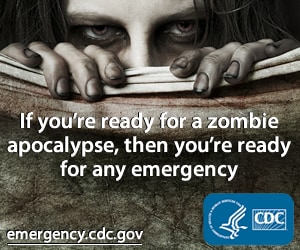
A great example of this can be seen in the Center for Disease Control's Zombie Apocalypse preparedness campaign.
If you're ready for a zombie apocalypse, then you're ready for any emergency. emergency.cdc.gov

What started as a joke turned into one of the CDC's most effective ways of reaching people with a traditional message in a new way. The Zombie Preparedness campaign does a good job of taking preparedness and giving it context that makes it accessible for everyone and not just people who are involved promoting preparedness. 

Creating new opportunities to interact with preparedness messaging is key to stakeholder engagement, and building on the success of some of the public service announcements posted previously, maybe this would be a good time to reach out and tap the professional marketers of the world to see if they can help.

If events like Burning Man are getting 50,000+ people to unwittingly put the beginnings of a preparedness kit together without really trying, then the community within emergency management can build on and learn from that to grow partnerships and get out to events that they wouldn't normally attend. 

So what do you think? Am I full of it, or is this a good idea? Have any examples of good preparedness campaigns? Share them below.


Thursday, August 8, 2013

Preparedness is about more than having a kit

Having the physical resources to get through a disaster are important: food, water, flashlights, a radio, medicine, a means to charge your phone, etc...these are some of the components that make up the foundation of self-sufficiency that everyone should have in preparation for an event. Many of you probably know much of this because physical preparedness is drilled into our heads, because it's tangible; you can create simple messaging around it and it’s easy to quantify impact and evaluate results. The tougher side, the side that is often overlooked and far more difficult to quantify, is creating social value in learning and passing on the knowledge of relevant information pertinent to response outside of: Make a Plan, Build a Kit, Get Involved.

Make a Plan | Build a Kit | Get Involved
This is the message that gets pushed at all levels of government, simple and straightforward, yet translating awareness into action remains a challenge. In the Booz Allen Hamilton paper: Mitigating Our Nation's Risks: Calling upon the Whole Community an examination of the psychology of behavior and what needs to happen in order to turn awareness into action is discussed. As it turns out, we all think a disaster is going to happen to anyone but us, and as a result, we can be lax in our approach to preparing for an event. This delusion is what ends up hampering response and recovery efforts down the line because many don’t know what to do and more importantly, what to expect.

Teach Someone To Build a Kit and They’ll Know How to Build a Kit
Disaster Preparedness is not just about having a kit and a meeting point, although those are integral aspects to personal preparedness; it’s about education and the setting and managing of expectations in an effort to help mitigate some of the confusion of an overwhelming situation. While there are a host of resources out there that reference preparedness, here are few topics that I think individuals would benefit from if included in preparedness materials:

Topic
Info
Insurance: Knowing what you’re covered for and an idea of how the process works will save you time and frustration.
·     How to read your policy
·     What’re you covered for?
·     How do you file a claim?
·     Does an Adjuster have to 
      conduct a site visit before I 
      begin cleaning up?
·     In lieu of a site visit will   
      photos or a video suffice?
Roles & Responsibilities: Knowing who is supposed to do what will work to mitigate a lot of misdirected anger.
·     What is FEMA’s role in         
       response?
·     What does the Red Cross 
       actually do?
·     An explanation of the FEMA 
      grant process
Timelines: Having a general idea on timing can help mitigate confusion and anger.
·     Search & Rescue
·     Response
·     Recovery
Long Term Recovery: What happens once everything is cleaned up?
·     Transition from cleanup to 
      Long Term Recovery
·     Long Term Recovery 
      Committee formation
·     Permitting process for 
      repairing and rebuilding

The point of the above is that there are more pieces of information out there that will help create a base level of understanding beyond existing messaging related to disaster preparedness.

So what do we do about it?
We need to approach this like any for profit enterprise would in an effort to try and change mindsets - use Marketing, PR, and Advertising and the many tools it has at its disposal. This is already happening and what's being produced is pretty cool...but in too much of an ad hoc manner. With operational budgets dwindling, finding room for advertising sounds ridiculous, and is. But there are people out there whose sole mission is to change the way we think about soap, toothbrushes, and dish detergent...why can't we hire those minds to help us think through how we can change mindsets around preparedness and do it in a way that will change behavior?


Let's Get Digital
Sites like Khan Academy and Ted Ed are examples of online education 2.0, they are places that people seek out to gain access to new ideas and perspectives...when was the last time you went to Ready.gov to do that or FEMA's Independent Study Website? The opportunity is there to create an online space that can act as a resource clearinghouse while providing access to tutorials, updates, and relevant content promoting preparedness.

or...

Let's Go Old Skool
I vividly remember Officer Grazonty standing in my Elementary School auditorium telling us about ‘Stranger Danger’ and how to be safe on Halloween 20+ years ago. I also remember D.A.R.E from high school, Drug Abuse Resistance Education. Of course we all made fun of it…but we remember it. And finally I remember P.A.S.S. from a safety lecture in reference to how to use a fire extinguisher. Maybe I'm Rainman and have a gift for remembering safety related information...or maybe I was in school and the confluence of age, environment, message, and speaker all worked to indelibly imprint these safety tips in my psyche. Based on that, I believe there are opportunities for integrating disaster preparedness into existing school curriculum: Earth Science, Health, Social Studies, etc...ways to illustrate a disasters' impact and what they can do and encourage their parents to do to help mitigate them.

If we are going to get serious about integrating disaster preparedness into a ‘whole of community’ paradigm, it can’t just be for senior level officers in Non-Profits and Emergency Management. Of course we want those people well versed in all things disaster, but the support of a community who has been involved in the planning will be a far greater asset than those who feel like they've been kept in the dark during response and recovery.

Monday, July 22, 2013

Dolla Dolla bills y'all

According to this NYTimes article, NY State Attorney General Eric Schniederman is questioning why so much of the money raised in response to SuperStorm Sandy remains unspent. While the article talks about why non-profit agencies and organizations have yet to spend/allocate all of the money received in response to the plea for financial support following Sandy, what it also does is highlight the mentality people have around money and disasters—a touchy subject to be sure.

The message being pushed when a disaster strikes is that 'cash is king,' that your dollars are far more valuable than a tractor-trailer of unsorted, used clothing. While a donation of your old clothing sound like a good idea in theory, in reality, it isn’t and I've seen firsthand the unintended impact of how those donations can do more harm than good. Money is good because it's flexible, requires little in the way of logistics and personnel to manage it, and can respond to dynamic post-disaster needs that shift every 24-48 hours. Once an organization starts receiving donations however, everyone has ideas on how that money could/should be spent. 

Some organizations tout their ability to turn your donations into goods and services on the ground quickly, those groups are often criticized because many question whether due diligence is undertaken to ensure that the dollars are being spent on those who truly need it. Then there are those organizations/groups who hold off on spending donations they receive, citing the need to wait and see what happens when the dust settles, they are criticized for not being responsive enough and for lacking transparency. 

It seems that even with the best intentions at heart, someone, somewhere isn't going to like how you're doing things and take you to task for it. So what's right when it comes to spending: fast and furious or slow and cautious? The answer that I've found is a healthy mix of both.

The Robin Hood Foundation awarded over $60 Million dollars following the 12.12.12 concert for Sandy Relief to local and national organizations, and did so in record time. The rationale being that they were just the name, they didn’t have the “do” capacity to spend the money on response and recovery activities, so why hold onto it? While the money was awarded to a wide variety of agencies and organizations, Robin Hood still drew criticism that they were spending the money too quickly and not being thoughtful enough about who it went to and whether some should be held for longer-term community needs.

On the flipside, as the NY Times article expounds upon, there are questions about the millions the Red Cross raised and why it hasn't been spent; but local groups aren’t immune either, groups like Occupy Sandy are feeling the heat as well. They have money in the coffers but are looking to see how far FEMA, insurance, and any additional financial assistance individuals, businesses, and the communities as a whole receive before applying their additional financial resources. Unfortunately, the thoughtful approach is rarely seen as thoughtful, it’s seen more as deceitful and usually draws harsh criticism. 

The bottom line where money is concerned is everyone will have an opinion: it's being spent too fast, it’s not being spent fast enough, it’s not being spent on the right things, etc. This butting of heads is unavoidable but the discussion it generates is central to holistic community recovery, and I believe that part of that discussion should focus on a greater degree of transparency around how donated dollars are being spent, not on the rate of expenditure.

This NewsOK article illustrates a great example of what it means to lose sight of where the donations are going. Following the Moore, OK tornadoes, a Red Cross text to give campaign raised several million dollars and Donors believed all of the money received via that campaign would be funneled to the recovery efforts—this was not entirely true and it was only after considerable pressure that this became the case. 

If we as a community of practice are going to encourage individuals to donate money to our organizations instead of giving clothing, then we have an obligation to show donors how their money is being spent in simple, unfettered terms. At the same time, those of you who donate money need to do your homework and understand that if you do not expressly communicate where your donation is to go, that organizations will apply it to their greatest need at that time or put it toward their general fund. While the debate over the ethics of such actions is heated, it’s common practice and you should be aware of it.

Just as important as educating and communicating with donors, is ensuring community leaders get a crash course in disaster economics before they have to go through it. Part of our jobs in promoting community resilience is to work harder on the front end so that when something does happen there is a familiarity with the process and expectations that will be placed upon them as it relates to the financial side of recovery efforts.

While the road to recovery is a long and bumpy one, educating donors and communities alike on the financial realities and timetables that come with building back better needs to take place. While you will never satisfy all of the people all of the time, working to educate around the realities communities will face can only help everyone in the long run.

Friday, July 19, 2013

and we're back...

While I wish I could say that I was doing something important, like hosting a meeting of the minds or presenting something groundbreaking to the UN, I can't...I stared at a wall for a few days. But I'm back, and if what the internet says is true (and when isn't it?) a lot has happened.


The Rockefeller's 100 Resilient cities challenge has launched their application process...there are a few rules as to who can enter but I encourage spreading this around as the more people who know the better. Urge your city council/mayor/manager/whomever to take a look and see how being awarded a grant of this nature could positively impact your community.

http://www.rockefellerfoundation.org/100-resilient-cities-centennial 

In poking around, the site also has a some good articles around resiliency...often we get wrapped up our bubble's that we forget there's a big world out there struggling with similar issues in creating communities better able to handle the impacts of disasters.

Lots more to come but I wanted to say hello and share the announcement from Rockefeller in the hopes that some of you may be in a position to help your community in a significant way.

Articles from the Rockefeller site:

Building Resilient Cities: http://www.rockefellerfoundation.org/blog/building-resilient-cities
Resilience Begins at Home: http://www.rockefellerfoundation.org/blog/resilience-begins-home